
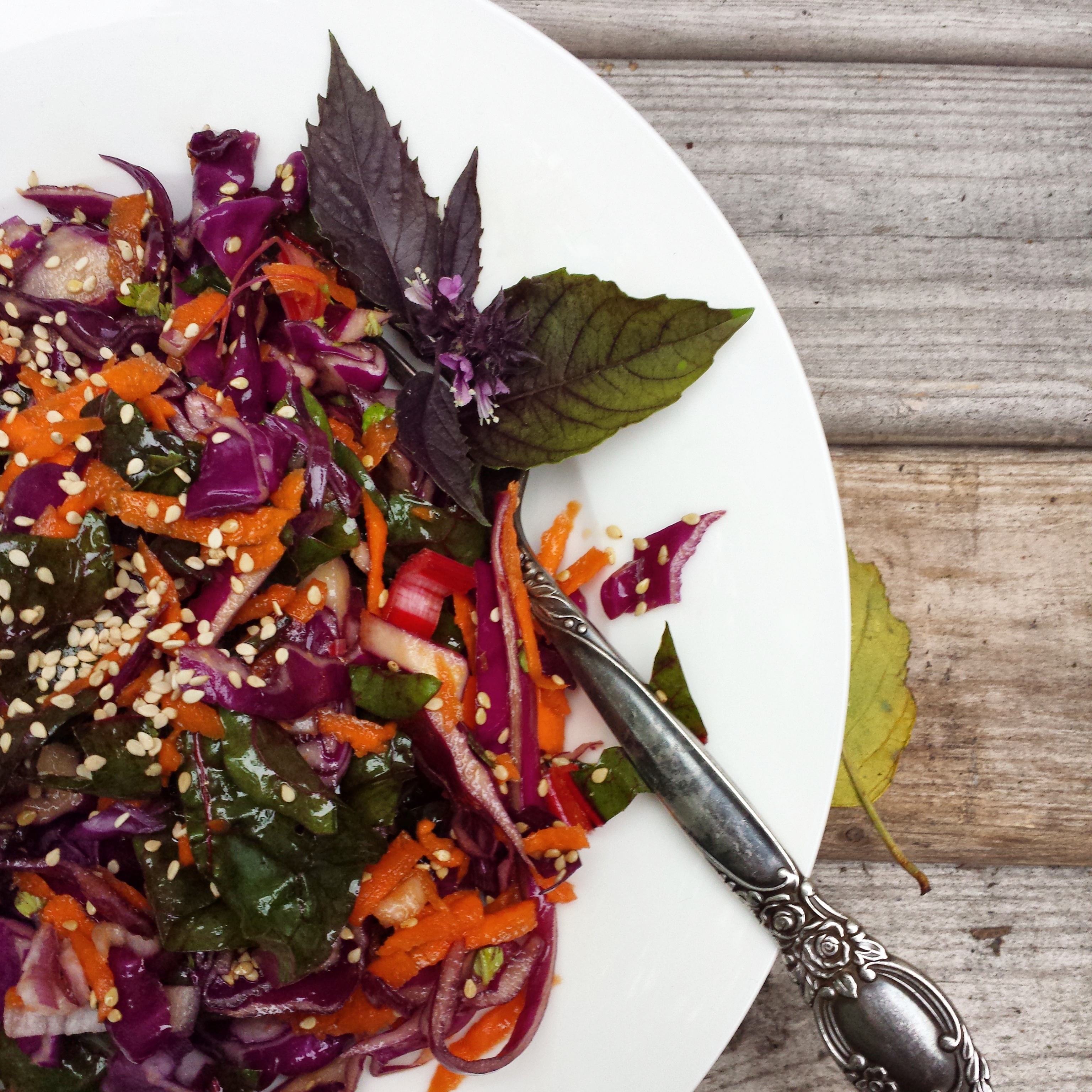
Asian-Inspired Cabbage and Swiss Chard Salad

Asian-Inspired Cabbage and Swiss Chard Salad

Summer is synonymous with salads, especially this year. Last summer I was only a couple of months into recovering from SIBO. Thusly,  salads or any raw vegetation, was almost out of the question. I pushed it with fruit, a.k.a vegetation candy, and rather regretted it. So this year, since my digestion has been getting better I’ve been partaking almost as much as I’ve wanted. I’ve indulged so much in fact that I actually hit the point where I wanted to try something beyond the normal salad of greens, carrots, cucumber, with mustard dressing.

Along with a desire to expand my salad horizons I’ve been looking for a reason to use purple cabbage. Beyond making sauerkraut of course. Purple cabbage is lovely and it’s becoming more understood that we should eat a variety of colors when it comes to food – #eattherainbow anyone?

This recipe was a happy accident.  It’s the result of leftovers from making another batch of sauerkraut. I had finished salting and squishing my sauerkraut like a good little DIY-fermenter and realized that there was just too much cabbage for my jar. Obviously I couldn’t waste it. Also, as it turns out raw salted cabbage is actually quite delicious and it makes purple cabbage – which isn’t my favorite – much tastier.

I was really feeling the pull make an Asian-inspired salad. However, I wanted to keep it simpler than many recipes I’d seen online which seem to call for ALL the ingredients in your fridge instead of just a couple. In my oppinion salads, especially those based on a recipe, should be simple and easy to remember – even I don’t want to spend a ton of time prepping veggies or continually checking a recipe for accuracy. Also, I prefer salads to not cost prohibitive. Cabbage is seriously cheap and carrots don’t break the bank either. So instead of going through my fridge looking for lots of ingredients to throw together, I looked for just a couple that would compliment cabbage instead of hiding it – which is my first instinct with raw cabbage. Cooked is another tasty treat all together!

Thus was born this super tasty recipe! Depending on the region in which you live you might be able to get these veggies locally – and possibly cheaper – in the spring and summer. But do what you want. I’m pretty sure sometime mid-winter I’m going to get a serious craving for it.
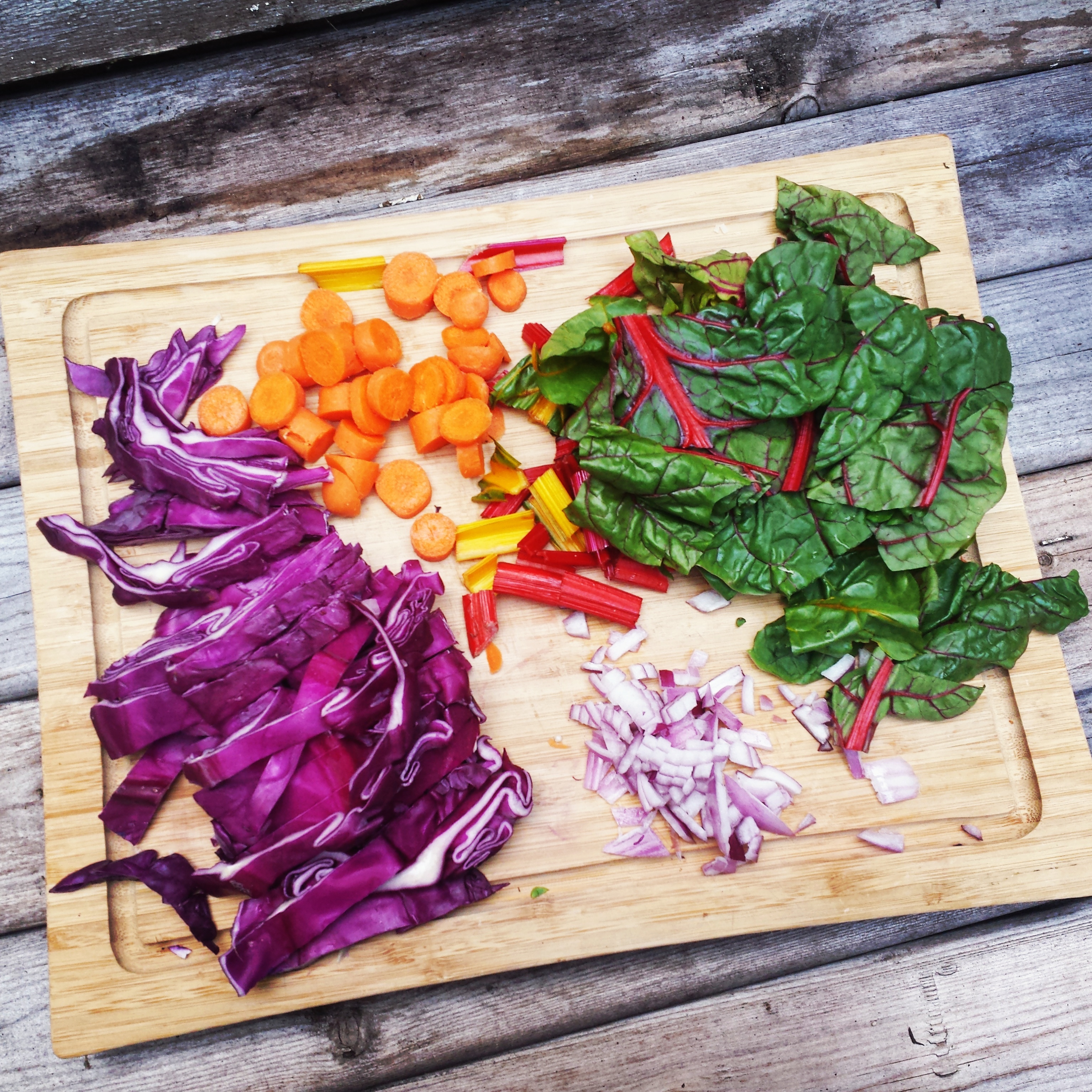
Asian-inspired salad ingredients
The start of something tasty!

The photo above is actually me just playing around as I was prepping to make the salad. I had no idea I’d actually like it. As such it doesn’t reflect the actual amounts of ingredients in the full recipe. But who doesn’t love veggies photos?

Salads are more versatile than often one thinks. They can make for great for breakfasts, lunches, secondsies, dinners, as main courses, sides, of snacks. One morning for breakfast I used it as a base and simply added two hard-boiled eggs and Trader Joe’s Garlic Herb Chicken Sausage. It would probably work with chicken, pork, or seafood. Tell me if you come up with other ideas for protein sources to build out this colorful salad!

 

Asian-inspired Cabbage and Swiss Chard Salad with Hard-boiled Eggs and Chicken Sausage

As a final note, if you are having digestive issues, be cautious with any raw vegetables. There is a time and place for them! However, if you are still having a rough time digesting raw vegetation be cautious with this recipe! I speak from experience, it pays to give yourself time to heal.

Asian-Inspired Cabbage and Swiss Chard Salad
Author: 
Recipe type: Salad
Prep time: 
Total time: 
Serves: 4
 
Ingredients
  • 4 cups - purple cabbage, thinly sliced
  • 3 cups - Swiss Chard, chopped
  • ¼ cup - red onion, diced
  • 3 large leaves - basil, diced
  • 3 - large carrots, grated
  • 3 tbsp - coconut aminos
  • 3 tbsp - toasted sesame oil
  • 2-3 pinches - sea salt
  • 1-2 sprinkles - sesame seeds for garnish
  • Optional: pistachios
Instructions
  1. Prep (chop and dice) veggies and basil
  2. Combine all veggies
  3. Add oil and coconut aminos
  4. Sprinkle with salt and toss to combine
  5. Sprinkle desired amount of sesame seeds
  6. Serve!
Notes
If you'd prefer your cabbage a little softer, slice first and sprinkle with a couple pinches of salt. Give it all a good smashing with your hands/fists - almost like you were going to make sauerkraut. Let sit for up to 15 minutes. Combine the rest of the ingredients. Sometimes I'll prep three cups of cabbage in this way and add the last cup of cabbage at the end for a mix of cabbage textures.

Since I'm not always the tidiest cook sometimes I'll throw all the ingredients into a bowl with a lid and give it a good few shakes instead of "tossing" the salad. Less spillage usually.

 

Beef Stock – Reuse those bones!

Nosh Nerd

Beef stock. I’m getting good at this one. My stock now feels as though it can finally pull a dish together. I’ve got the time down – 30 hours. If I put too much water in it, I just off set the lid for a little while and it will condense. Even my “seconds” beef stock is awesome.

Let’s talk about secondsies, and maybe even thirdsies.

There are plenty of directions out there for making the first round of broth. Check out here and here, both are great! But what I want to draw attention to is re-using those bones. Yes, seconds won’t be as decadent a broth, but waste not, want not(clearly, I’m an 80 year old woman). Beyond not wasting the bones for monetary reasons, I think the animals that become our food deserve the respect we can show them by not wasting their lives. Don’t waste their meat and offal. Use the bones until they don’t make a proper broth anymore!

It should be noted that not all bones are created equal. I’m not just speaking about factory farmed animals, but also the species of bones you use. For instance, chicken bones don’t always last to make a second batch. If you shoot for the 20-24 hour mark for making chicken stock like I do, the bones start to crumble into almost nothing. They just don’t last beyond that. Beef bones on the other hand are great for making a second and sometimes a third batch of broth. Use your own judgment as to when the bones are really, really done.

When and how to start

Once you have finished making your first batch of beef bone broth you can jump right into making the second batch, or you can freeze the bones for use later. Normally, I do the latter, because I get bored easily and need to switch up the proteins and types of meals. Either way, give the bones a good poke and toss the ones that are starting to get too crumbly. Some bones break down faster and won’t contribute much in the way of deliciousness.


Beef Stock


Beef Stock Seconds
Author: 
Recipe type: Beef Broth - Secondsies
Prep time: 
Cook time: 
Total time: 
Serves: 2 quarts
 
Ingredients
  • Mix of beef bones - saved from previous batch of bone broth
  • Enough water to cover bones
  • 2 tbsp of apple cider vinegar
Instructions
  1. Place bones in slow cooker
  2. Add enough water to just cover the bones
  3. Add cider vinegar - or sub another acid - I've used lemon juice in a pinch
  4. Turn the slow cooker on low and set for the longest time option - mine goes only to 10 hours, I simply reset it a couple of times over about 30 hours. It's perfectly safe to let it go up to 48 hours.
  5. Optional: if you use veggies to flavor the broth, put them in when there are about 6 total hours left. If you use herbs wait until the last hour to half hour of cook time, otherwise the broth will end up tasting bitter.
Notes
I've heard that if you let the bones sit in water for an hour with your acid of choice that it helps to draw out more minerals from the bones. I have not tasted a difference or seen data supporting this which is why I don't recommend it. If you have data to share supporting this please do!
 

Storing Secondsies

You can freeze the broth for later use. Make sure to label it with the date and the type of broth! I’ve made that mistake too often thinking I was defrosting a veggie broth and it turned out to be beef stock. If you are a canner, go ahead and can that shish! Or you can stick it in the fridge and it will last about a week, which is what I usually do. Dating and labeling fridge bound broth is a good idea as well for obvious reasons. I’ve “lost” stock in the fridge and didn’t find it again for a couple of weeks or longer. Wasted broth makes me super sad.

Using Your Tasty Broth

In case you are wondering how to use this stock beyond just making soup, here are a few of the ways I use mine:

  • Added to a sauce such as spaghetti – let it condense while cooking so that it’s not too watery.
  • To create a sauce – deglaze a pan you’ve just cooked a similar protein in add seasonings and voila! you have a tasty sauce for your protein or vegetable dish.
  • Broth for braising – I do a lot of cooking with cheaper cuts of meat because if done well they are amazing and it saves mulah. Check out my Beef Shanks Slow Cooker Recipe.
  • Drinking – on occasion I’ll just chop some green onions and season broth to drink, especially if I’m fighting something off. To be fair, it’s not my favorite thing but whatever.